 +33 (0)7 84 05 73 75
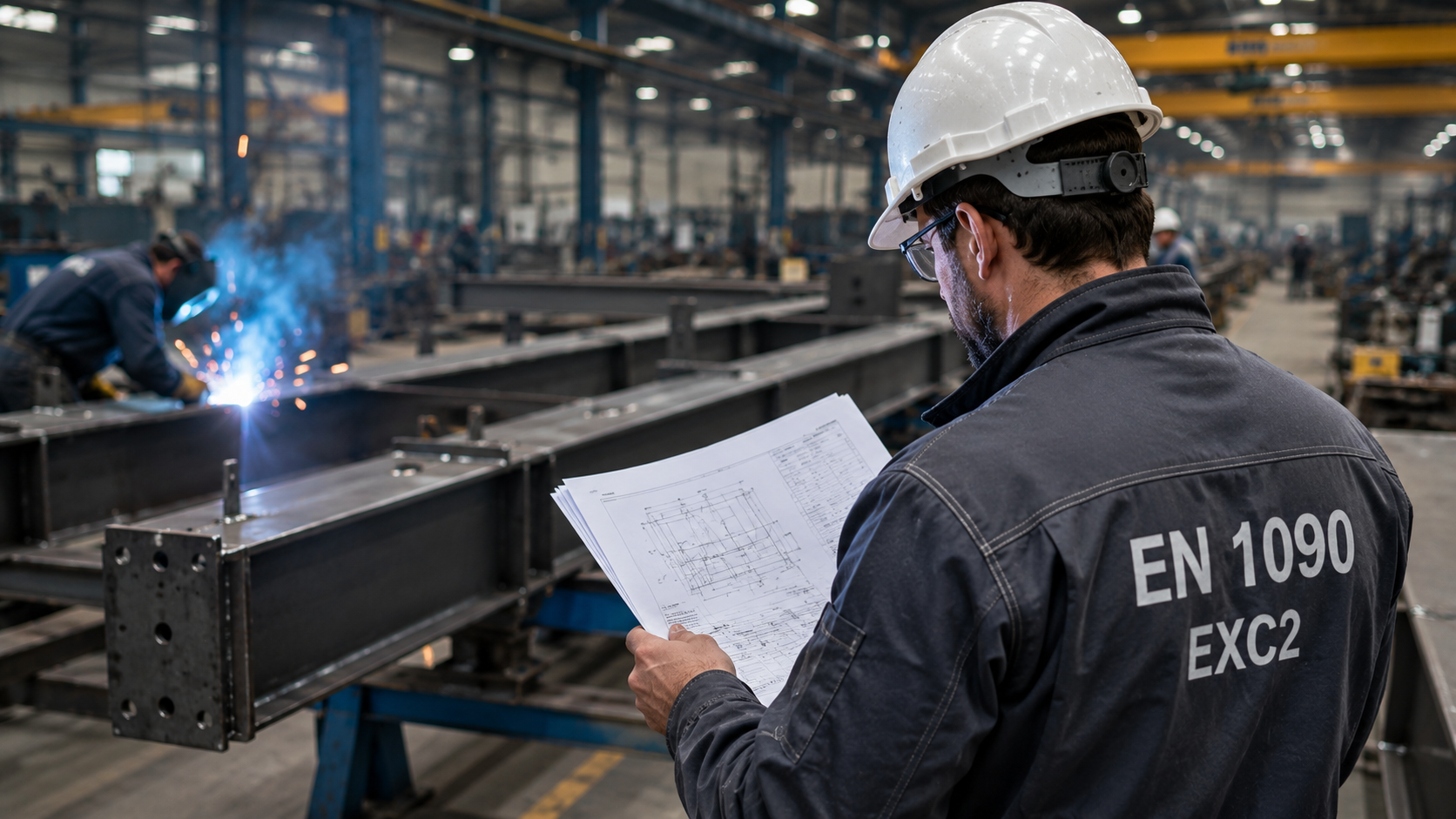
CE marking of structural steel components has been mandatory since 1 July 2014. Yet many quotes still arrive without an EN 1090 certificate, or with a certificate that does not cover the required execution class. Here is what a buyer, an engineering firm or a metal fabricator should check before placing an order.
EN 1090 in brief
EN 1090 governs the execution of steel and aluminium structures. It has three parts:
- EN 1090-1: the rules for conformity assessment and CE marking of structural components. This is the part harmonised under the Construction Products Regulation.
- EN 1090-2: the technical requirements for the execution of steel structures (materials, cutting, welding, bolting, tolerances, corrosion protection, inspection).
- EN 1090-3: the equivalent for aluminium.
In practice, any component that contributes to the stability of a structure and is placed on the EU market must carry CE marking under EN 1090-1: beams, columns, portal frames, roof structures – but also staircases, walkways, platforms, mezzanines and supports for heavy equipment.
The key point: the execution class (EXC)
The execution class sets the level of requirements for fabrication and inspection. It is chosen by the designer of the structure, based on the consequences of failure, the type of loading (static or fatigue) and the production category.
| Class | Typical examples | Level of requirements |
|---|---|---|
| EXC1 | Agricultural buildings, stairs and railings in private houses | Basic |
| EXC2 | Most industrial and commercial buildings, factory stairs and walkways | Standard |
| EXC3 | Grandstands, large public buildings, road bridges | High |
| EXC4 | Structures with extreme consequences of failure (major railway bridges, sensitive facilities) | Very high |
A workshop certified to EXC2 cannot CE-mark an EXC3 component. This is the most common mistake: the supplier shows a valid certificate, but its class is lower than the project's. If your specification states no class, EN 1090-2 defaults to EXC2.
The 6 documents to require from your subcontractor
1. The factory production control (FPC) certificate
It proves that the workshop runs a production control system audited by a notified body. Check three things: the name and exact address of the factory that will make your parts, the maximum execution class covered, and the validity date. The notified body's number can be checked in the EU NANDO database.
2. The welding certificate
Often issued together with the FPC certificate, it confirms that the workshop controls its welding processes at the level required by the class: EN ISO 3834-3 for EXC2, EN ISO 3834-2 for EXC3 and EXC4.
3. The welding coordinator
The workshop must appoint a welding coordinator whose level of knowledge (EN ISO 14731) matches the class and the thicknesses involved. Ask for the person's name and qualification.
4. Welder and welding procedure qualifications
Every welder working on your parts must be qualified to EN ISO 9606-1 for the process, position and thickness range used. Welding procedure specifications and qualification records (WPS/WPQR to EN ISO 15614-1) must cover the steel grades of your project, for example S235 or S355.
5. The declaration of performance (DoP)
On delivery, the manufacturer provides a declaration of performance and affixes the CE marking (label or accompanying document). The DoP states in particular the execution class, the declared characteristics and the design method used.
6. The traceability file
3.1 material certificates to EN 10204 for plates and sections, dimensional inspection reports, non-destructive testing reports (visual, penetrant, magnetic particle, ultrasonic depending on the class), galvanising certificate or paint report with measured thicknesses.
The most common pitfalls
- Another factory's certificate. An intermediary shows one workshop's certificate, then has the parts made elsewhere. The certificate must show the address of the production site.
- An insufficient class. An EXC2 certificate for an EXC3 structure – see above.
- An expired or suspended certificate. Ask for a recent copy and check it with the notified body.
- CE marking "forgotten" on secondary parts. An access stair to a walkway or a machine support are structural components: they must be marked too.
- Cascading subcontracting. If galvanising, laser cutting or bending are subcontracted, the certified workshop remains responsible for controlling them: ask how it does so.
What if the workshop is in another EU country?
The standard is European: an EN 1090 certificate issued in Bulgaria, Romania or Poland by a notified body has the same value as one issued in France or Germany. This is a decisive advantage over non-EU suppliers, where CE marking is harder to verify and legal responsibility often falls on the importer.
With a European subcontractor, the requirements stay the same: same documents, same inspections. The only practical difference is the language of the documents – hence the value of a contact who checks them and hands them over in English or French.
How Fab Sourcing secures your EN 1090 purchases
We only work with workshops whose FPC certificate, execution class and welding qualifications we have checked on site. For every order, we provide the complete file: DoP, material certificates, inspection reports and finishing documents. Our partner workshop FabTec is certified up to execution class EXC3.
Do you have a structure, staircase or walkway project? Send us your drawings and the required execution class: we will come back to you within 48 hours with a price and the list of documents supplied.