 +33 (0)7 84 05 73 75
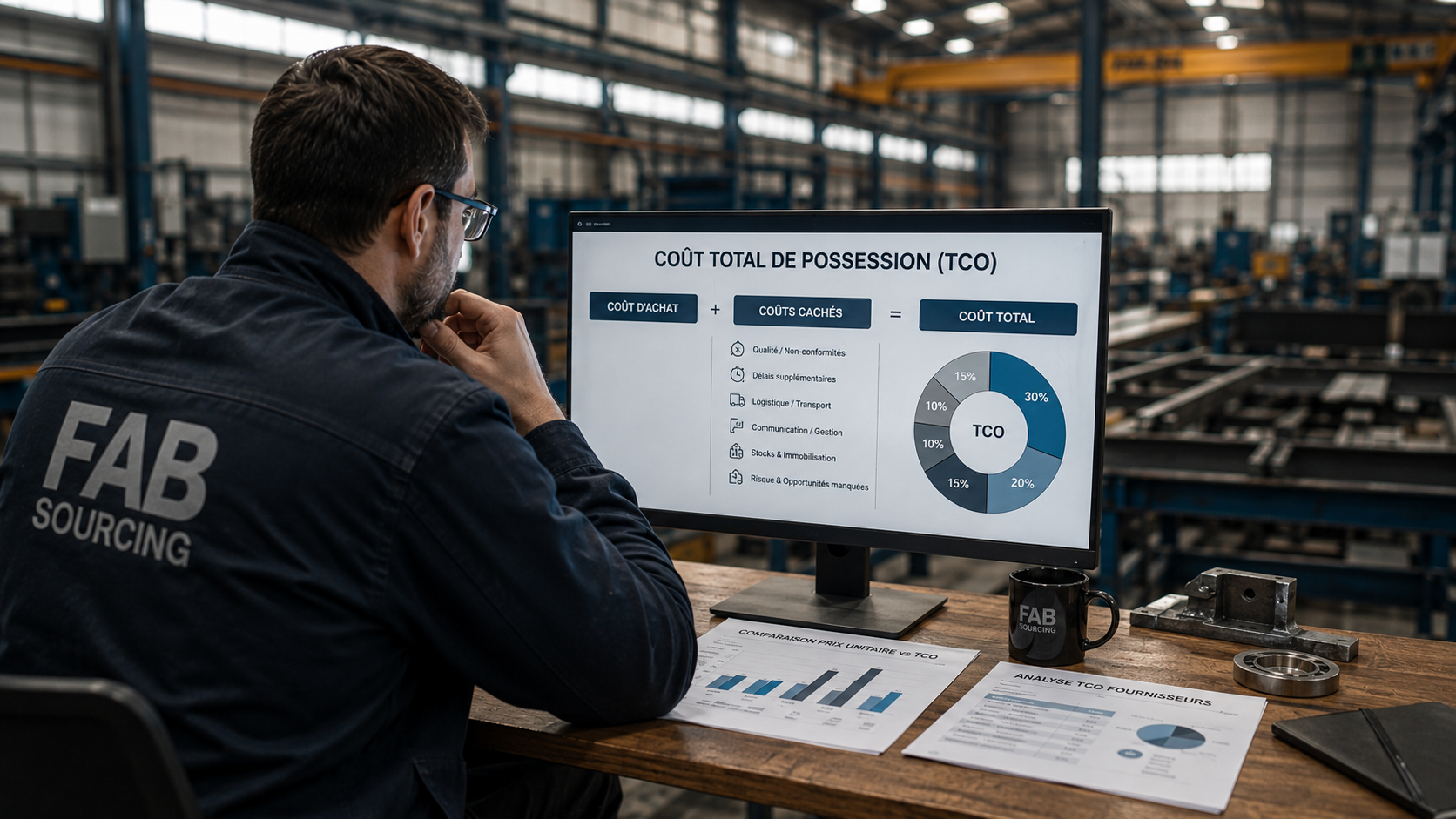
Two quotes for the same part: €145 and €168. Most buyers pick the first. Yet once transport, stock, non-conformities and the time spent managing the supplier are added, the cheapest offer is often the most expensive. This method has a name: total cost of ownership, or TCO.
What is TCO?
TCO adds up everything a purchased part really costs you, from the order to its use on your line or site. It is calculated per part and per year, so that offers with different volumes and lead times can be compared.
TCO = MP + T + S + Q + C + O + R
MP = manufacturing price, T = transport, S = stock, Q = quality, C = coordination, O = tooling, R = risks. Each item is detailed below.
A typical case: 2,000 spill trays per year
A European equipment manufacturer needs 2,000 steel spill trays a year. It receives two serious offers:
- Offer A, a Turkish workshop contacted for the first time: €145 per part, 4-week lead time.
- Offer B, an EN 1090-certified Bulgarian workshop: €168 per part, 3-week lead time.
On paper, A is 16% cheaper. Here is the full calculation:
| Item (€ per part) | Offer A – Turkey | Offer B – Bulgaria |
|---|---|---|
| Manufacturing price (MP) | 145 | 168 |
| Transport and customs (T) | 18 | 12 |
| Safety stock (S) | 8 | 2 |
| Non-conformities (Q) | 8 | 1 |
| Internal coordination (C) | 4 | 1 |
| Tooling and prototypes (O) | 3 | 2 |
| Risks: delays, exchange rate, audits (R) | 5 | 2 |
| TCO per part | 191 | 188 |
Offer B, €23 more expensive to buy, ends up €3 cheaper per part once everything is counted – a saving of €6,000 a year on 2,000 parts. And this calculation is conservative: it counts only one quality incident and no site delays.
The 7 cost items, one by one
Item 1: manufacturing price (MP)
This is the ex-works price: material, cutting, bending, welding, finishing. Check three points before comparing: is material included and at what market price, is scrap charged, is the finish (galvanising, powder coating) priced? A €12 quote that becomes €14 once painting is added is no longer the cheapest.
Item 2: transport and logistics (T)
Truck, insurance, packaging, handling and, for a non-EU country, customs clearance and – depending on the country – duties or safeguard measures on steel. Beware of quotes saying "transport to be confirmed": a dedicated truck booked in a hurry easily costs 40% more than planned groupage.
Item 3: stock (S)
The longer and less reliable the lead time, the more safety stock you hold. Its cost is:
S = (average stock × unit price × carrying rate) / annual volume
With 300 parts in stock at €150, a carrying rate of 20% a year and 2,000 parts a year, stock costs €4.50 per part. With a reliable supplier delivering in 3 weeks, 50 parts are enough: €0.75 per part. The difference is €7,500 a year.
Item 4: quality (Q)
A non-conforming part is paid for several times: rework or remake, delay, overtime, sometimes customer penalties. If a non-conformity costs you €150 on average, a 5% rate adds €7.50 per part; a 0.5% rate adds only €0.75.
Item 5: coordination (C)
This is your team's time: chasing, exchanging drawings, translation, delivery follow-up. At €50 an hour, 12 hours a month represent €3.60 per part on 2,000 parts a year. With a single point of contact, 2 hours are often enough: €0.60 per part, a saving of €6,000 a year.
Item 6: tooling and prototypes (O)
Machine programming, welding jigs, first parts. Ask whether these costs are included, and for what quantity: programming "included" only up to 500 parts will be charged again on the second order.
Item 7: risks (R)
Supply disruption, exchange-rate changes, regulatory changes (the EU Carbon Border Adjustment Mechanism applies to steel imported from outside the EU), travel to audit a new supplier. This item is hard to quantify, but ignoring it means setting it at zero – which is always wrong.
5 questions to ask before signing
- What has your non-conformity rate been over the last 12 months, and how do you measure it?
- What is your actual average lead time, compared with the lead time quoted?
- What is not included in the quote: transport, packaging, tooling, drawing changes?
- How do you trace material: 3.1 certificates, batch tracking?
- What happens in case of machine breakdown or overload – do you have a back-up workshop?
What Fab Sourcing changes in your TCO
- Transport: groupage of shipments from several customers, with no customs since Bulgaria is in the EU and the euro zone.
- Stock: short, regular lead times, so less safety stock.
- Quality: workshops audited on site, inspection before shipment, compliance file supplied.
- Coordination: one point of contact, from quote to delivery.
- Risks: a network of several workshops, so production can be switched if something goes wrong.
Conclusion
Unit price is a data point; TCO is the reality of your profit and loss account. The right question is not "which quote is cheapest?" but "how much does this relationship cost me, in total and over time?".
Send us your drawings and annual volumes: within 48 hours we will send you a detailed quote, item by item, that you can compare with your current offers.